
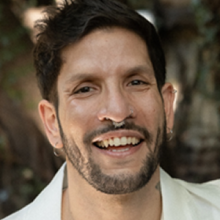
Q: What is something you learned to do in the last month?
A: To do dropbacks. I’ve been practicing Ashtanga yoga every morning for six years, six days a week, and despite increased flexibility and technique, they just wouldn’t happen. There was also fear—and, if I’m honest, a certain amount of avoidance. They felt impossible. I spent a month in Argentina, and the teachers I practiced with there—José Carballal, Rafa Martínez, and Patricia Aballay—didn’t ask too many questions or give me much time to explain my lower-back issues. Instead, they didn’t leave much room for complaint and more or less threw me into it.
I’m deeply grateful for that. Something that had felt impossible (or at least very far away) began to move. There’s still a long road ahead, but as K. Pattabhi Jois used to say: Practice, and all is coming. I learned that sometimes the body already knows; what’s missing is crossing the threshold of fear.
Q: What is a typical day like for you?
A: I wake up at 5am. I clean my tongue, brush my teeth, walk my dog and feed them. I have an espresso and head to my shala. Once there, I shower and begin my practice, which lasts between an hour and a half and two hours. On the way back home, I listen to the news and/or call mum and friends (we Latinas love sending voice notes that could easily turn into podcasts, and then responding to them hours—or days—later), have breakfast, and shower again. Depending on the day, I teach classes, work from home, or get Licenciado Taquito (my wire-haired dachshund) ready to come with me to the office. Half of the year we commute by bike and the other half by bus or subway—because I live in Boston, I’m from the Majority World, from a warm climate, and there’s a point in the winter when biking stops being a viable plan and turns into an act of faith. I try not to work past 6pm. At work, I balance time with students, meetings, teaching, grading, and writing/research. In the evenings, I really enjoy cooking dinner, having a glass of wine, and reading and/or watching TV shows. By 9pm, my eyes are literally closing, so I don’t last much longer than that.
Q: How does your cultural context influence you?
A: My research is shaped by my position as a Mexican trans* scholar working within U.S. developmental psychology while remaining intellectually grounded in Latin American travesti and trans genealogies. Thinkers such as Marlene Wayar, Lohana Berkins, Claudia Rodríguez, and Susy Shock have taught me to understand life—and knowledge itself—as something lived in motion, what Wayar calls ser en gerundio.
Susy Shock’s idea of crianzas—to raise and to create at the same time—has been especially formative for how I think about childhood. It frames children not as incomplete adults moving toward stability, but as active participants in processes of care, invention, and relation. From this cultural horizon, I approach developmental research with caution toward models that privilege coherence, adult-defined baselines, and categorical endpoints as indicators of health.
Practically, this means I read variability as meaningful rather than pathological, attend closely to whose voices anchor longitudinal designs, and treat measurement as a moral and political practice—not a neutral one. My cultural context doesn’t just inform what I study; it shapes how I ask questions, interpret data, and remain accountable to the communities whose lives are being represented in research.
Q: How do you see your research contributing to Global Child Development?
A: My research contributes by offering an alternative way to understand development that does not equate health with stability or change with failure. Across longitudinal and qualitative studies with transgender and nonbinary youth in different national contexts, my work shows that identity movement itself is not what predicts distress. Rather, distress consistently tracks social exclusion, while affirmation and belonging support wellbeing regardless of whether identities remain constant or shift( shout out to my amazing Dutch co-thinkers Jessie Hillekens and Lysanne te Brinke!). This has broader implications for how child development is theorized globally. By centering relational conditions—such as care, recognition, and exclusion—my work shifts attention away from whether children “arrive” at stable categories and toward how social environments shape developmental possibilities. It invites developmental science to model trajectories, contexts, and relations, rather than treating change as deviation from a presumed norm. More broadly, by putting travesti and trans* ways of knowing into conversation with mainstream developmental theory, my research expands what counts as developmental knowledge. It argues for a science capable of holding constancy and transformation together—one that understands children’s movement not as instability, but as a meaningful response to the worlds they inhabit.
Q: How has collaborating with international colleagues enhanced your work?
A: I would not be where I am without a loving and brilliant network of colleagues. I don’t want to fall into clichés or sentimentality about “needing a tribe,” but the truth is that my trajectory is profoundly collective. From my doctoral training—when Germán Posada and Olga Alicia Carbonell, two leading attachment theory scholars in Latin America, served on my dissertation committee—to more recent work on parental burnout and temperament that is now widely cited and earns me a number of “points” that may be somewhat undeserved in a field that can be perverse, meritocratic, and obsessed with numerical indicators of supposed impact.
More important than the outputs is how these collaborations have shaped my thinking. My understanding of childhoods, care, and childrearing as rights—not only to be guaranteed by the State, but to be sustained through concrete resources and programs—owes a great deal to my Uruguayan sisters Paola Silva and Verónica Cambón. My (still limited) knowledge of more sophisticated quantitative analyses I owe to my bestie Pedro Alexandre Costa in Portugal. Beyond that, working together has allowed us to study multiple countries and contexts, and to develop a particular linguistic and cultural sensitivity. And yes—they have also been my favorite coauthor.