
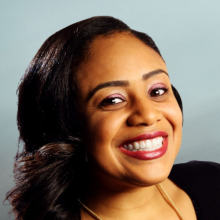
Bio:
Elan C. Hope, Ph.D., is Vice President of Research and Evaluation at Policy Research Associates (PRA). PRA is a woman-owned small business with a mission to “create positive social change for people and communities through technical assistance, research, and training.” Dr. Hope is an award-winning author of over 75 articles and an expert in youth development, racial justice, and well-being within schools and communities. In her research, Dr. Hope uses community-centered quantitative and qualitative methods to understand individual and structural factors related to behavioral health and well-being, with a focus on innovative practices and policies that address racial injustice. Before joining PRA, Dr. Hope was an associate professor of psychology and a university scholar at NC State University. Dr. Hope is from Prince George’s County, Maryland, and earned her Bachelor’s degree in Psychology from Smith College and her Ph. D. in Education and Psychology from the University of Michigan. Following graduate school, Dr. Hope completed a post-doctoral fellowship (sponsored by the William T. Grant Foundation) in Comparative Human Development at the University of Chicago. Dr. Hope is also the Editor of the Journal of Adolescent Research, which publishes qualitative and mixed-methods developmental science research focused on adolescence and young adulthood.
Q: Why did you decide to choose developmental science as a course of study or career?
A: I was drawn to a career in development science because of my deep care for Black children and the communities that raise them. Rooted in my own experiences growing up in Prince George's County, Maryland, I wanted to understand what parts of the individual and broader society support thriving and development from adolescence into adulthood. From that primary question, I have been able to use developmental science not just to understand how and why development happens, but also to use what we know from science to improve conditions so that more and more people have opportunities to thrive, even when historically those opportunities have been stunted.
Q: What advice would you give to a student beginning their Ph. D. studies in developmental science or related?
A: My advice to our next generation of scholars is to set your internal compass and revisit it often. A Ph. D. is an opportunity to become deeply knowledgeable about a particular topic and to learn how to shape the future of our understanding of human beings. This journey can challenge and push you, so you must always return to the fundamental reasons you care about topics you are learning about and the people you are working with. This compass will help guide you when you have to make tough choices throughout your student journey and into your career.
Q: Why did you join the Black Caucus and how does it facilitate connection among members all year long?
A: I joined the Black Caucus because I believe in the power of community. The Black Caucus is a space where developmental scientists who care deeply about Black people and Black communities come together to learn from and collaborate with one another, and to generally have a good time. I love connecting at SRCD events and conferences, Black Caucus events online, and all the informal connections made between events throughout the year. Through the Black Caucus, I have had the opportunity to contribute to a body of work and a community of scholars dedicated to Black communities. Most importantly, I have gained mentors, colleagues, mentees, and friends.