
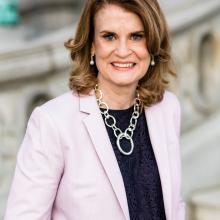
Bio:
Suzanne Le Menestrel, Ph.D., CAE is SRCD’s Executive Director. Dr. Le Menestrel is the chief administrative director at the Society and furthers the strategic goals of the Society through the implementation of scientific initiatives in collaboration with our staff and Governing Council. Before joining SRCD, Dr. Le Menestrel was a Senior Program Officer in the Board on Children, Youth, and Families, at the National Academies of Sciences, Engineering, and Medicine where she directed five consensus studies on the well-being of children and families. Prior to her tenure with the National Academies, she was the founding national program leader for youth development research at 4-H National Headquarters, U.S. Department of Agriculture and was a research scientist at Child Trends. Dr. Le Menestrel was also a founder of the Journal of Youth Development and chaired its publications committee. She has published in numerous refereed journals and has been an invited member of research advisory groups and not-for-profit boards of directors, including the Consortium of Social Science Associations, and is a volunteer mentor for the Dream Project. Dr. Le Menestrel holds a B.S. in psychology from St. Lawrence University and an M.S. and Ph.D. in human development and family studies from The Pennsylvania State University. She also has a nonprofit management executive certificate from Georgetown University, and she is a certified association executive and Gold Award Girl Scout.
Q: Why did you decide to choose developmental science as a course of study or career?
A: I first became interested in developmental science as a course of study when I worked as a group home house parent in between undergraduate and graduate school. Like many people with a bachelor’s degree in psychology, I wanted to be a therapist and “help people” but didn’t really know what this meant in the real world. The adolescent girls who I cared for had been in and out of systems of care because of abuse and neglect. Most if not all the girls suffered from severe trauma and had resultant challenges in school, with peers, and at the group home. This was one of the most challenging jobs I’ve ever had. I decided after that experience that I wanted to focus on prevention science with a focus on programs to strengthen families and focus on positive youth development. At Penn State, I worked on a longitudinal study of Dr. Anne Petersen’s focused on the prevention of adolescent prevention. This experience affirmed my interest in positive youth development, an area of research that I am still extremely interested in today.
Q: What are you most proud of in your career?
A: I am most proud of collaborating on the creation of a new refereed journal in the field of positive youth development, Journal of Youth Development, as a place for both practitioners and researchers to publish high quality research and evaluation studies. I am also very proud of a National Academies consensus study that I directed and that was chaired by Dr. Greg Duncan entitled A Roadmap to Reducing Child Poverty. Finally, I have a very strong commitment to mentoring, both in my personal and professional lives, and I’m very proud of all of the staff and students that I have mentored over the course of my career and the amazing things that they are doing now. Each one has found their passion, and I am happy to be a small part of that.
Q: Do you have a mentor, or mentors, who have been instrumental to your career and, if so, who and how?
A: Yes, Dr. Anne C. Petersen was my mentor at Penn State, and she was the one who first introduced me to how to conduct a rigorous intervention study, encouraged me to submit my research to the SRCD Biennial Meeting and SRA, and taught me how to effectively synthesize and present research. I also had two wonderful mentors at the U.S. Department of Agriculture when I worked as the national program leader for youth development research. Dr. Dan Kugler was one of my supervisors who believed in me as a leader and an innovator and taught me that creativity could be fostered within a large government agency. Dr. Lisa Lauxman, also one of my bosses, was always an enthusiastic, supportive, and innovative leader. She believed in the power of youth to change the world and supported all of my ideas to strengthen 4-H’s focus on research and evidence.
Q: Outside of developmental science, what hobbies or activities do you engage in or enjoy?
A: For the past five years, I have volunteered as a mentor to high school seniors, all immigrants and first-generation college students, whose immigration statuses pose barriers to attending college. Four of the five students are enrolled in college and the fifth will begin college this fall. I also enjoy strength training, especially slamming a heavy medicine ball on the ground; traveling for work and fun; going to see live theater, comedy, and music; spending time with family and friends; and reading. I recommend The Emperor of Gladness by Ocean Vuong, the most recent book I’ve read.
For more information about Suzanne Le Menestrel, Ph. D., CAE:
https://www.researchgate.net/profile/Suzanne-Le-Menestrel/research